


The Philippine Game Development Expo returned in 2026 with greater scale, deeper industry participation, and an increasingly international outlook.
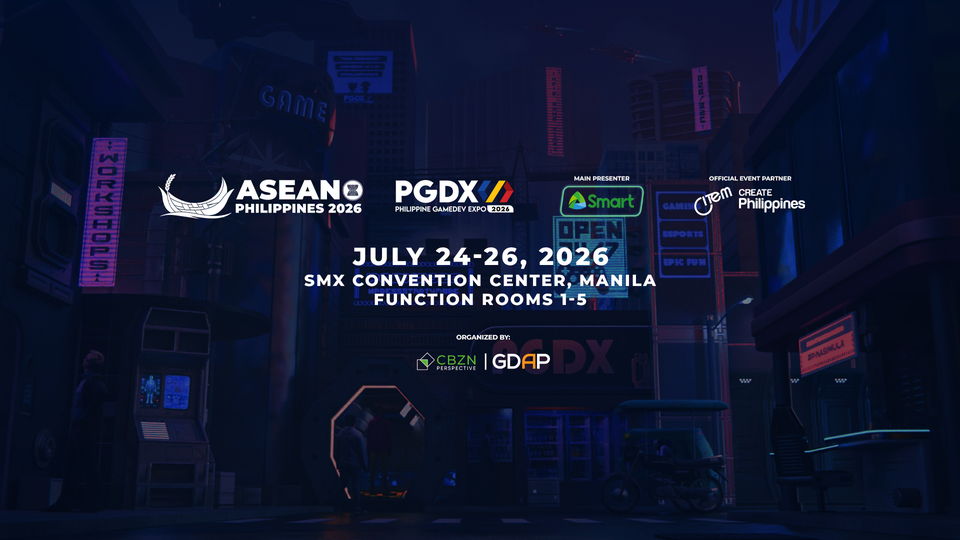
Held from July 24 to 26, 2026, at the SMX Convention Center Manila, the fourth edition of the Philippine Game Development Expo, or PGDX, carried the theme “PGDXpanding.” The theme reflected not only the physical growth of the event but also the continued expansion of the Philippine gaming, digital art, animation, technology, and creative industries.
Organized by CBZN Perspective and the Game Developers Association of the Philippines, or GDAP, PGDX 2026 brought together a wide range of participants. Passionate gamers, content creators, aspiring developers, established studios, publishers, artists, technology companies, investors, researchers, and other industry professionals gathered in one space to experience games, exchange knowledge, form partnerships, and explore where the industry may be headed next.
More than a conventional gaming convention, PGDX has become a place where different parts of the creative and technology ecosystem meet. It is where games are introduced, ideas are tested, research is shared, tools are demonstrated, and relationships begin to take shape.
A Three-Day Celebration of Gaming Culture
PGDX 2026 offered three days of gaming, technology, education, networking, and community activities.
The event featured more than 100 exhibitors showcasing developments in gaming and technology, as well as over 50 independent games representing local and regional creative talent. With approximately 10,000 attendees, it stood as one of the largest gaming events in the Philippines.
For players, the expo provided an opportunity to discover new games and meet the people behind them. For aspiring developers, it offered a closer look at the tools, processes, communities, and possible career paths involved in game creation. Established studios and companies were able to meet potential partners, creators, professionals, and audiences.
Whether someone was looking for a new independent title, exploring how to launch a game, searching for collaborators, or simply hoping to connect with others who share an interest in gaming, the event offered several ways to participate.
PGDX 2026 used a tiered ticketing system designed around different attendee goals:
- Expo Ticketsprovided access to the main exhibition floor.
- B2B Ticketsallowed entry into professional networking areas.
- Workshop Ticketsgave participants access to hands-on learning sessions and specialized talks.
Each ticket tier created a different experience. Casual attendees could explore the exhibits and games, while professionals, students, and aspiring creators could participate in more focused learning and industry engagement.
Beyond the Expo Floor
Although the Expo Hall was filled with game demonstrations, booths, technologies, and interactive experiences, some of the most meaningful conversations took place in the business-to-business area and workshop spaces.
These sections of PGDX allowed participants to network directly with professionals, learn from experts, and understand how creative skills are applied in real production environments.
The B2B Hall also revealed how wide the modern gaming industry has become. Game development now intersects with digital art, animation, hardware, artificial intelligence, content creation, market research, entrepreneurship, education, investment, marketing, and community building.
PGDX provided a setting where these areas could be discussed not as separate industries, but as connected parts of a much larger ecosystem.
Wacom and the Importance of Human Creativity
One of the standout experiences in the B2B Hall was a conversation with professionals from Wacom Philippines, including Kristel Puno, who plays an active role in connecting the creative community with industry opportunities.
Wacom’s participation demonstrated how technology companies can support artists beyond simply selling equipment. The company has built relationships with creative organizations and educational communities throughout the Philippines.
Wacom has supported organizations such as Graphic Artist Philippines and has contributed to educational initiatives involving schools such as CSDA in Baguio City. Its presence at PGDX provided further evidence of this commitment.
The company’s social responsibility is visible not only in written announcements or published articles, but also through its continued participation and direct engagement with creative communities.
Wacom has been present at and supported the Philippine Game Development Expo since the event began in 2023. Its continued involvement through 2026 reflects a long-term commitment to the local gaming and creative industries.
At the heart of Wacom’s philosophy is a belief in human creativity and the intention behind every work of art. For the company, games are not defined only by programming and technical systems. Their worlds are also shaped by visual development, concept art, storytelling, character design, environments, and the creative decisions that give each experience its identity.
Wacom aims to provide artists with the tools needed to bring these ideas to life.
Concept Art as Storytelling and Problem-Solving
A major educational highlight was the Wacom Concept Art Workshop, facilitated in collaboration with Musings Art Academy.
Participants received hands-on experience using Wacom pen tablets and were introduced to the role digital tools play in modern creative workflows.
The workshop emphasized that concept art is not simply about producing an attractive drawing. It is a form of visual storytelling and problem-solving.
Concept artists help determine how a game’s world, characters, objects, environments, and atmosphere should appear before those ideas move further into production. Their work gives developers and other members of a creative team a visual foundation from which to build.
In immersive gaming experiences, this process is essential. Strong concept art can clarify an idea, establish a consistent visual language, communicate emotion, and help different departments work toward the same creative vision.
By giving participants direct experience with professional digital tools, the workshop connected artistic expression with the realities of modern game production.
The Philippines as an Emerging Creative Hub
Conversations with Wacom also highlighted the opportunities available to Filipino artists and creative professionals.
From Wacom’s perspective, the Philippines has significant room to grow within the international creative economy. The country has an established pool of talented artists, designers, animators, and developers, but it is still developing its position as a globally recognized creative hub.
The Western creative industry benefited from an early and strong start, but parts of that market are now slowing down. At the same time, countries in the East, including China, South Korea, and particularly Japan, have been building bridges and creating stronger connections with Filipino creatives.
These developments may create new opportunities for Filipino artists to contribute to international productions, participate in cross-border collaborations, and expand their careers beyond the local market.
Strengthening Creative Connections with Japan
The international direction of the Philippine creative industry was also reflected in a recent delegation to Japan.
The Multimedia Council of the Philippines, which was present in the PGDX B2B Hall and where Kristel serves as a board member, joined Wacom headquarters in an international creative delegation.
On July 14 and 15, 2026, MACP, in partnership with the Cebu Creative Entertainment Council and UNIDO ITPO, brought Filipino creatives to Tokyo.
The initiative was designed to strengthen collaboration, explore new opportunities, and build lasting relationships with Japan’s creative industry.
The delegation included visits to HAL and TOEI Animation, along with discussions with industry leaders working across different creative sectors.
This mission represented another step toward advancing the Philippine creative economy and empowering Filipino multimedia artists, animators, filmmakers, and game developers.
It also highlighted the growing relationship between the Philippines and Japan in digital art, animation, multimedia production, and game development. By creating direct connections between Filipino talent and established Japanese institutions, initiatives such as this may open more opportunities for international partnerships, knowledge exchange, professional development, and global career growth.
Niko Partners and the Data Behind the Gaming Industry
Another important encounter in the B2B Hall was with Darang Candra, who represented Niko Partners.
Darang was invited and supported by the Game Developers Association of the Philippines and the Center for International Trade Expositions and Missions.
What first drew my attention was the Niko Partners booth. It felt intentional, professional, and firmly grounded in data.
After scanning the booth’s QR code, I was directed to the company’s whitepapers and research reports. That was when the meaning of “data-driven” became much clearer within the context of their work.
The booth was not simply designed to appear analytical. It reflected how Niko Partners operates as a company.
Its work is based on primary research conducted across Asia and the Middle East and North Africa, or MENA. The company performs large-scale surveys, tracks gaming markets, studies audience behavior, and analyzes the economic and regulatory forces affecting games and esports.
One example is its research on Generation Z esports fans. Niko Partners surveyed thousands of respondents to understand how an audience numbering in the hundreds of millions engages with games, brands, esports, and competitive play.
The research showed that behind the excitement and entertainment of esports is an extensive layer of analytics influencing business strategies, investments, product development, marketing decisions, and audience engagement.
From Market Research to Business Decisions
Niko Partners collects primary data and monitors gaming activity across several countries. It also provides tools such as NikoIQ, which companies can use to study trends and make informed business decisions.
The company’s presence at PGDX showed how the gaming industry is evolving into something increasingly structured, analytical, and insight-led.
Another detail that stood out in the company’s materials was the reach of its research. Niko Partners’ findings have been cited by major international media organizations, including The New York Times, Forbes, Bloomberg, Reuters, the BBC, and the Financial Times.
This helped demonstrate that its insights contribute to conversations beyond gaming. The company’s work also informs broader discussions involving technology, consumer behavior, business development, digital economies, and emerging markets.
Niko Partners has operated since 2002 and focuses specifically on video games and esports across Asia and other emerging markets.
Its research covers player behavior, monetization, regulation, audience development, and industry growth. These areas are critical for understanding where gaming is headed and how companies should respond to rapidly changing markets.
The company also projects continued and significant growth for the gaming market across Asia and MENA in the coming years. This growth places the scale and future potential of the industry into perspective.
An Open and Enthusiastic Philippine Community
Darang also shared that PGDX networking activities allowed him to meet many game studios from across the Philippines.
He described the local community as enthusiastic, welcoming, and open to collaboration. That sense of openness could also be felt throughout the event.
Developers were willing to explain their work. Artists shared their processes. Startups discussed their goals. Industry representatives spoke about opportunities, challenges, and areas where the Philippines could continue to grow.
Alongside local studios and organizations, global companies such as Google and Razer were also present within the PGDX environment.
The combination of local talent and international participation reinforced the idea that gaming today is no longer only about playing games.
It is also a space for entrepreneurship, research, technology, marketing, investment, media, education, and business development. Data plays an increasingly important role in shaping every one of these areas.
Bridging Creativity and Code
The Philippine Game Development Expo has become more than a venue where finished games are displayed. It is also a place where stories and partnerships begin.
Developers, creators, technology companies, researchers, and communities meet and quietly influence what the future of gaming in Southeast Asia might become.
At PGDX 2026, many of the conversations felt personal. Behind the booths, software demonstrations, and presentations were people trying to make the industry more accessible, inclusive, collaborative, and human.
Among them were Superbullet AI and The Magic Rain.
The two groups operate on different sides of the gaming ecosystem, but both are working toward a similar goal: helping more people participate in gaming and game development.
Making Game Development Feel Possible
For many people, game development still feels inaccessible.
It can appear highly technical, intimidating, and reserved for those who already understand programming. The idea of building a game may seem impossible without years of coding experience or access to specialized education.
This is the barrier Superbullet AI is attempting to reduce.
Representing the team at PGDX was Heart Belle Chan Fermin, a founding operator who spoke openly about the company’s goal of simplifying game development.
The platform has been described as something similar to ChatGPT for Roblox developers. Instead of requiring users to write every element from scratch, it allows them to begin building games through prompts.
The concept is simple, but potentially powerful. Someone with limited or no development experience can begin creating.
Children, students, families, aspiring designers, and first-time developers can explore what it means to build a game. By connecting directly with Roblox Studio, the platform helps turn ideas into working prototypes without requiring users to complete years of technical training before they can begin experimenting.
Human-Made Assets Behind the Technology
Alongside Heart Belle Chan Fermin were other members of the Superbullet AI team, including Ralph, who explained more of the technical process behind the platform.
He discussed how the system connects with Roblox Studio and accesses an internal marketplace of assets.
Importantly, these assets are not simply produced at random. They are created by developers, artists, and designers within the team.
This preserves a human element within the platform. Although artificial intelligence helps users navigate the development process, human creators remain responsible for producing and shaping many of the resources that support the final outputs.
The broader vision comes from Superbullet AI founder and chief executive officer Erickson Talaue.
Erickson began learning at a young age. He taught himself to code and created Roblox games that eventually opened larger opportunities for him.
That experience helped shape what Superbullet AI has become.
The platform is not being presented solely as a piece of software. It is also intended to offer others the kind of starting point that Erickson once found for himself.
Finding the Middle Ground with Artificial Intelligence
It is difficult to discuss a platform such as Superbullet AI without addressing the wider concerns surrounding artificial intelligence.
Artists, designers, developers, and other professionals have expressed understandable hesitation about technologies that may affect their work. Many worry that automation could eventually replace the people responsible for creating games, artwork, and digital experiences.
Heart Belle Chan Fermin acknowledged these concerns directly. The conversation did not avoid the tension surrounding artificial intelligence. Instead, it addressed the issue openly.
For Superbullet AI, the stated goal is not to replace people. It is to support them.
The platform is intended to make workflows lighter, reduce some of the technical barriers involved in game development, and give creators more space to think, experiment, and develop ideas.
As explained during the discussion, artificial intelligence should make people’s jobs easier rather than take those jobs away.
The platform’s reliance on human-made assets supports this position. Artists and developers remain part of the process. The technology is designed to work with them, rather than operate entirely in their place.
This question of balance appeared in several conversations throughout PGDX.
The future of gaming does not necessarily have to be framed as a choice between humans and machines. Instead, it may involve a continuous effort to determine how technology can support human imagination, creativity, judgment, and skill.
The Magic Rain and the Role of Community
If Superbullet AI represents access to tools, The Magic Rain represents access to people and communities.
Through content creator and streamer talavt, The Magic Rain presented another side of the modern gaming industry.
The Magic Rain is a media platform covering gaming, anime, and popular culture. However, its work extends beyond publishing content. It has developed into something more active and community-driven.
One of its largest initiatives is IndieJam.
What began as a smaller effort has grown into a space where developers, streamers, investors, audiences, and fans can meet. It brings together voices from across Southeast Asia and creates opportunities for collaboration.
According to talavt, The Magic Rain’s strength lies in its ability to connect different parts of the gaming ecosystem.
The goal is not only to produce articles, videos, or entertainment coverage. It is also to create moments in which people can meet, exchange ideas, discover projects, and support one another.
A Diverse Gaming Audience
IndieJam reflects the diversity of contemporary gaming audiences.
Some players are attracted to narrative-driven experiences, including visual novels. Others prefer highly competitive titles or faster-paced games.
Rather than separating these communities, IndieJam brings them into the same environment.
The initiative also recognizes the growing influence of streamers and content creators.
Creators are no longer only members of an audience reacting to finished games. They now play a major role in how games are discovered, interpreted, experienced, discussed, and shared.
A creator may introduce a new independent game to an audience that would otherwise never encounter it. Streamers can also provide developers with immediate feedback, help form communities around new titles, and influence how players understand a game.
In this environment, creators have become an important bridge between developers, audiences, brands, and the wider gaming industry.
Superbullet AI as a Starting Point
Before the conversation with Superbullet AI concluded, the team was asked what they would say to future users.
The responses came naturally, but what stood out was how personal they felt.
There was an openness in the message. It did not feel limited to promoting a product. It felt like an invitation for people to try something unfamiliar, explore new possibilities, and discover where the process might lead.
For Paolo and the broader team, platforms such as Superbullet AI are not only tools for building games. They are starting points.
A user might begin by creating something as simple as a room or a small interactive experience. Even a modest experiment could eventually grow into something larger.
It could become a personal project, a new skill, a portfolio piece, or even the beginning of a career.
Success was not presented as something distant, exclusive, or available only to experts. It was described as something that may become possible when people are given an accessible place to begin, particularly at a time when technology is developing so quickly.
The team also understood that not everyone enters the gaming industry from the same background.
Some people begin in programming or game development. Others come from marketing, media, art, design, communications, or entirely different fields.
The message remained consistent: exploring new tools can reveal unexpected directions. It can help people understand what they want to pursue and what they may be capable of building.
More than anything, the team emphasized openness.
Technology is advancing rapidly, and people are continually faced with the choice of whether to engage with it or remain on the sidelines. For the Superbullet AI team, it is worth exploring.
The conversation echoed an important sentiment: a lack of resources should not prevent someone from starting.
Tools are available to provide guidance, and users do not need to know everything at the beginning.
That is where Superbullet AI positions itself.
It is not presented as the complete answer. It is presented as a way in.
It offers people a way to start, experiment, and build without limits.
PGDX as a Space for Opportunity
What connects these conversations is PGDX itself.
Events like the Philippine Game Development Expo make it easier for ideas, opportunities, and relationships to move.
They allow startups, creators, technology companies, artists, investors, researchers, educators, and communities to find one another. They make possible conversations and collaborations that might not otherwise happen.
For Superbullet AI, the Philippines represents an important next step.
Heart shared that the company is working toward establishing a stronger local presence. Its plans include building a talent pool and eventually creating internship and employment opportunities.
For The Magic Rain, PGDX provides a way to strengthen connections across Southeast Asia.
With communities already developing across the Philippines, Malaysia, and Indonesia, The Magic Rain aims to continue building bridges between creators, audiences, developers, and other members of the regional gaming ecosystem.
Expanding the Philippine Gaming Ecosystem
What became clear throughout PGDX 2026 was that the Philippine gaming ecosystem is not developing in isolation.
Local artists are forming stronger connections with Japan and other international creative industries. Technology companies such as Wacom are supporting education and professional development. Researchers such as Niko Partners are bringing data and market intelligence into the conversation. Companies such as Superbullet AI are attempting to lower the barriers to game creation. Platforms such as The Magic Rain are strengthening communities across national borders.
Established global companies, including Google and Razer, are participating alongside Philippine studios and independent creators.
These interactions demonstrate how many different people and organizations are required to build a sustainable gaming industry.
Games need developers, but they also need artists, writers, designers, researchers, marketers, creators, educators, investors, community organizers, hardware providers, media platforms, and audiences.
PGDX creates a space where these different contributions become visible.
More Than a Gaming Event
PGDX 2026 was more than a celebration of games.
It was a platform for growth, creativity, education, entrepreneurship, and collaboration.
From independent developers to global companies, and from aspiring artists to experienced professionals, the event continued to support the Philippines’ rapidly expanding gaming ecosystem.
The conversations with Wacom, Niko Partners, Superbullet AI, The Magic Rain, and the many studios and professionals present at the event showed that the industry is becoming more connected, professional, and internationally engaged.
It is being shaped not only by advances in technology but also by people who believe in creative expression, accessible education, informed decision-making, and strong communities.
Superbullet AI focuses on access. It gives people a way to start creating even when they are not yet experts.
The Magic Rain focuses on connection. It creates spaces where people can meet, share, learn, and grow together.
Wacom supports the human creativity and visual storytelling that give games their character and emotional impact.
Niko Partners provides the research and market intelligence needed to understand how gaming audiences, businesses, regulations, and economies are changing.
At PGDX, these efforts meet in the same space.
Moving Forward
The future of gaming does not have to feel closed or inaccessible.
PGDX 2026 showed that it can be open, collaborative, and filled with different entry points.
A person may begin as a player, a student, an artist, a streamer, a researcher, a marketer, or someone experimenting with a tool for the first time. Through the right communities and opportunities, that first step can develop into a project, profession, business, or long-term creative practice.
For gamers, artists, content creators, entrepreneurs, and future developers, PGDX offers evidence that the Philippine industry is not only thriving. It is also preparing to compete, collaborate, and contribute on a global stage.
Perhaps that is the most important message from the event.
People do not need to know everything before they begin.
They simply need a place to start.
PGDX is increasingly becoming that place.


