


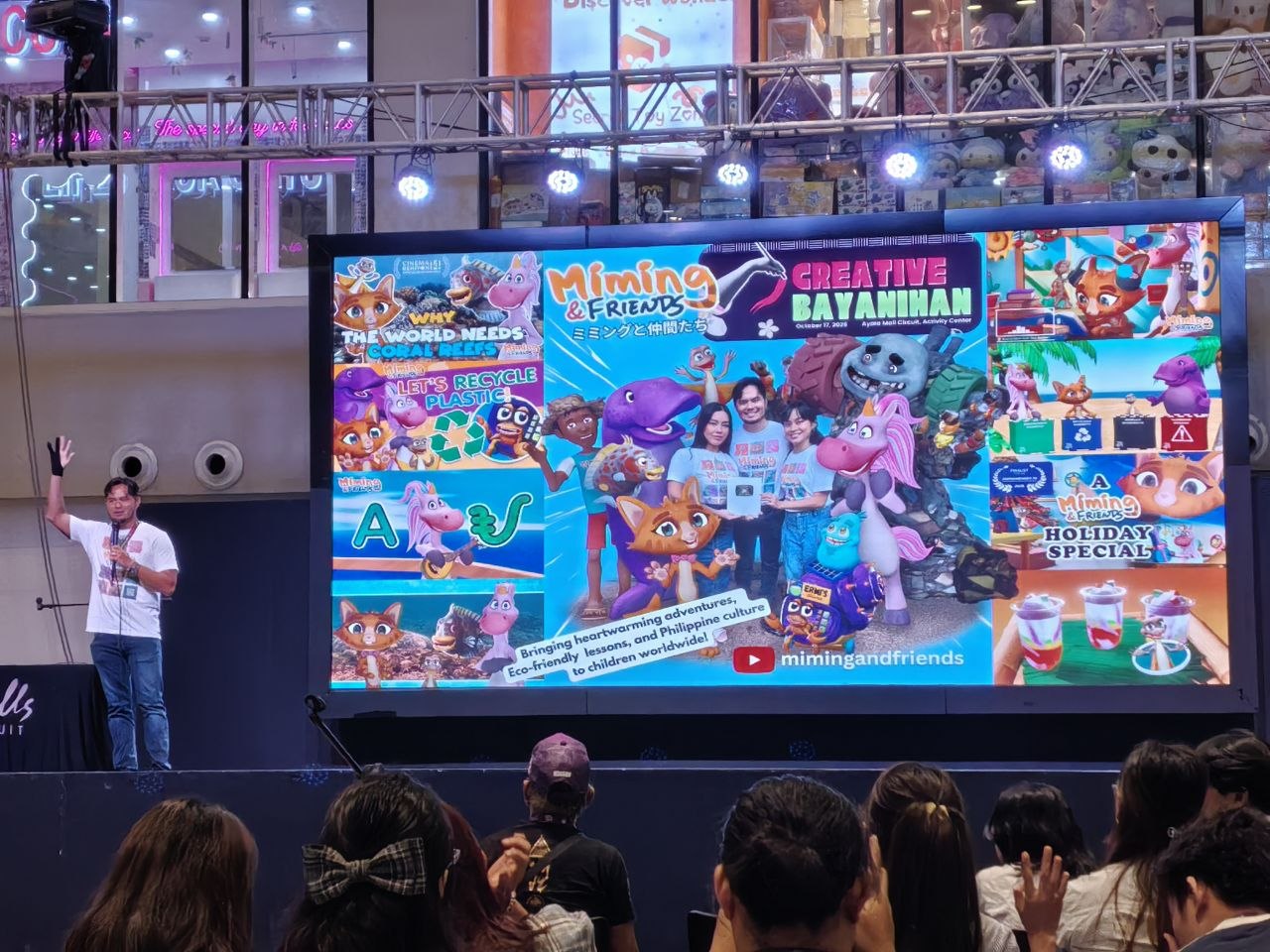
Creative Bayanihan 2026 successfully concluded its two-day program hosted by the Graphic Artists of the Philippines (GAP) in collaboration with the Design Center as part of Design Week Philippines’ 15th-anniversary edition. The workshops were held at the New Taguig City Hall on October 16, 2026, and Ayala Malls Circuit on October 17, 2026.
Breaking into the creative industry is no easy feat, especially for those in the provinces who often lack support, mentors, or peers on the same path. Patrick Acma shared how he braved his solo journey despite the odds. The biggest takeaway from Acma’s workshop session is the value of one’s work springing from purpose. He said that anything that comes from the heart will flourish, even amid external circumstances such as the rising role of AI in the creative industry.
Part of his talk shed light on the role of Filipino creatives in multinational companies like Pixar and Disney, as the country is one of the key players in outsourcing animation services worldwide. His workshop throughout the morning included a demonstration of animation doodling from basic shapes and various proportions, and participants also shared their own created animation characters in his Basic Drawing workshop
The second workshop, Photography in Communities and Public Spaces, featured Fotomoto’s Veejay Villafranca, who discussed the current state of documentary photography in today’s world. Compared to the content one sees on social media, there is a lack of forums where photographers can receive proper analysis and feedback on the work they produce. Perhaps, with the presence of social media, they think their work is done.
As a former news photographer, he emphasized the need to become immersed by spending time with the people who are the subjects of the photographs. This takes time, given that one must obtain informed consent. Indeed, it is not about finding content to post, but about giving time and space to plan and tell a story.
Villafranca noted that Filipino photographers are recognized worldwide, and that many Filipinas, particularly LGBTQ+ photographers, work as sports photographers in the Philippines.
As creative work increasingly circulates online, questions of ownership, authenticity, and consent become more pressing. In his workshop, Protecting Your Work from Generative AI, Rollan Bañez emphasized the need for digital watermarks and fingerprints to protect designs, as well as watermark detection through blockchain.
Bañez encouraged participants to examine the origins of digital content and ask who or what created it. The possibility that publicly available images may be incorporated into AI training datasets raises important questions about creators’ control over their work and the implications of publishing it online.
Anything we put online or upload may become part of a dataset. That is why the concepts of self-preservation and control over what, where, when, or how to publish are key to preventing the risk of having our information included in a dataset.
His session also introduced the Content Authenticity Initiative (CAI), established through collaboration among major technology companies. The C2PA is the blueprint and one of the initiatives that implements the conference’s ideas. Content Credentials include metadata, fingerprinting, and watermarks. They can collect information such as your name, the software used, edits made, and even whether AI was involved.
Much of the discussion focused on the relevance of AI to the creative industry. Bañez believes that the presence of artificial intelligence is to take the positives and leave out the negatives. For instance, Generative AI is primarily beneficial for video editing, particularly for subtitles.
Nick Automatic, one of the most sought-after speakers at the Creative Bayanihan workshops and speaker of the Building a Visual Identity Through T-Shirts workshop, is a multidisciplinary artist who began his creative career as an illustrator for children’s books. He is now known for his clothing brand and for building visual identities through T-shirts. He said that a visual identity does not necessarily need a logo or name when people already know who created it. He believes that one’s strongest asset is one’s visual identity, not one’s logo.
“Sometimes, what we create for fun can become something bigger than we imagined.”
His message to the younger generation was: “Your art can go FURTHER than you THINK.”
- Use social media as your portfolio, and make the most of these platforms as a creative.
- Be thoughtful of what can be seen in your portfolio, and ensure that companies can see what you create.
On the second day of the workshop held at Ayala Circuit Makati, speaker Roq Cleo passionately emphasized the importance of understanding clients’ pain points and emotions to address their specific frustrations in his Choose Your Battle: How to Find the Market Gap Your Brand Can Own workshop. This is the market gap that a brand can own by addressing these needs. It is about understanding customers’ negative feelings and turning them into positive experiences.
Both strategy and execution are important, but execution, which he calls “activation,” is key. He develops strategy to solve customers’ problems, not those of the company or its owners. Turning the discussion toward the business side of creativity, he noted that small and medium-sized businesses do not view branding as a strategy because they think it is unnecessary. In contrast, big companies understand that marketing is valuable.
He voiced the need to incorporate design thinking into Philippine higher education, which is already part of Ateneo’s curriculum, and argued that the government curricula should be updated to reflect industry demands.
Cleo encourages students to invest in AI education. However, he also encourages young people to refrain from using AI until after college. He values knowledge-based and human creation and believes that anything requiring hard labor will be valuable in the future.
Next was Ran Carmona, a graphic artist specializing in concept design (visualizing character and story elements) and character design, leading the Character & Concept Design Creating Lores and World Building workshop.
Carmona noted that companies sometimes provide no visuals, only descriptions and words. That is when asking questions becomes valuable. Because professional settings are fast-paced, artists must deliver quality with efficiency to meet clients’ standards and deadlines.
His advice for overcoming creative blocks is to think of an object and turn it into a character. He has used this approach in his own designs and emphasized the importance of thorough research. For example, he drew inspiration from Filipino Indigenous Peoples (IPs) to create a Badjao water bender and a T’boli fire bender, then revised his tribal designs in response to feedback from his followers.
The third speaker was Ramon del Prado, creator of the YouTube channel Miming & Friends. His Let’s Create a Character workshop shows that his entire process begins with planning and drafting, followed by sculpting and modeling using basic shapes, applying textures and materials to the model’s surface, rigging (creating an internal skeleton), animation, lighting, rendering, and compositing.
Ramon demonstrated retopology on a large screen, much to the delight of the audience. He showed the entire process of character design, explaining how the way a character is built affects its movements in animation and allowing the audience to appreciate the transformation.
He explained that character design is not just about creating something cute; it is also about creating characters with whom audiences can connect and appreciate.
The event’s final speakers were a group from Greyline Studios, who presented Pass the Mic: The State of Merch Design. They shared their experiences with challenges such as clients offering low rates and client-requested revisions, as well as how they navigate these issues.
Their discussion added an important dimension to the workshops’ broader message. Creative work can be fulfilling, but sustaining a career requires more than talent; it also requires strategy and persistence.
Across two days of workshops, Creative Bayanihan 2026 brought together speakers with varied perspectives on what it takes to build a creative career: finding purpose in one’s work, telling stories responsibly, protecting intellectual property, developing a visual identity, understanding customers, and mastering the technical processes behind animation and design.
Together, these discussions highlighted the importance of nurturing Filipino creative talent, equipping artists with the know-how and providing information on the current state of the creative industry.


